
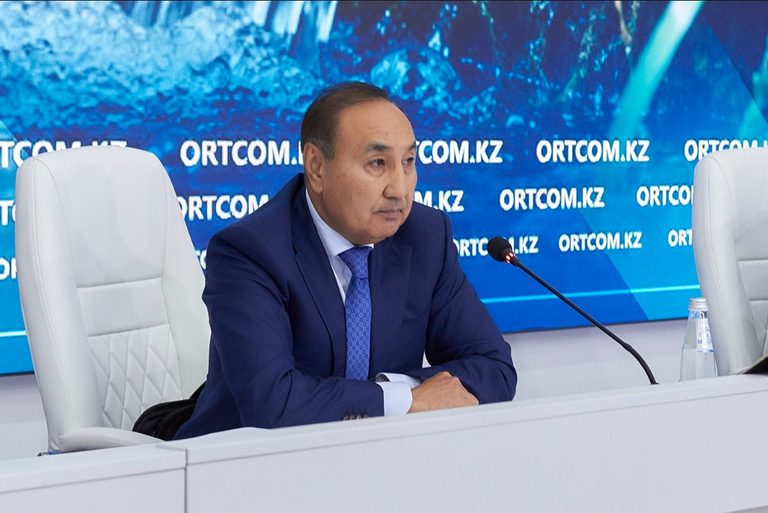
Deputy Minister Talgat Momyshev reported on industrial water reuse plans and water conservation education at a Central Communications Service briefing.
English translation · Russian original
Water-saving efforts also cover industrial enterprises. The Water Code requires industrial enterprises to move progressively to circulating and reused water supply systems over seven years. The measure is intended to increase the share of reused water from the current 13.3% to 28% by 2030. Deputy Minister of Water Resources and Irrigation Talgat Momyshev reported this at a Central Communications Service press conference.
Additional regulations are being adopted. They govern reductions in permitted water use when users fail to implement their action plans, as well as the form and content of industrial enterprises' plans for moving to circulating and reused water supply.
“These measures provide for a gradual reduction in non-productive water losses. To date, 191 transition plans have been developed, 91 are awaiting approval and 278 are being prepared. As part of these measures, the Ministry has also approved a schedule of meetings with industrial enterprises to explain the Water Code and regulations on the transition to reused and circulating water,” the Deputy Minister said.
Work to foster careful use of water is also continuing.
In his Address to the People of Kazakhstan on 8 September 2025, the President again emphasised the need for a comprehensive approach to conserving natural resources, particularly water, and the importance of awareness-raising and values-focused work among citizens, especially younger people.
The Ministry is promoting water-saving habits among the population. Under the Water Conservation Roadmap, it has worked with local executive bodies since 2024 to raise awareness of responsible water use by placing information materials in airports, public transport and administrative buildings.
In the 2025–2026 academic year, water-saving awareness activities under the “Save Water – Preserve the Future!” project reached more than 3.3 million students in schools, colleges and universities.
Within schools' unified educational methodology, the “Save Water – Preserve the Future!” project is becoming an optional lesson in which students undertake water-related science projects. A shared communication character, the animated Tamshy, has been created as a symbol of effective water conservation. Tamshy is the central character in public-service videos, environmental fairy tales, educational games and interactive content for children and young people.