
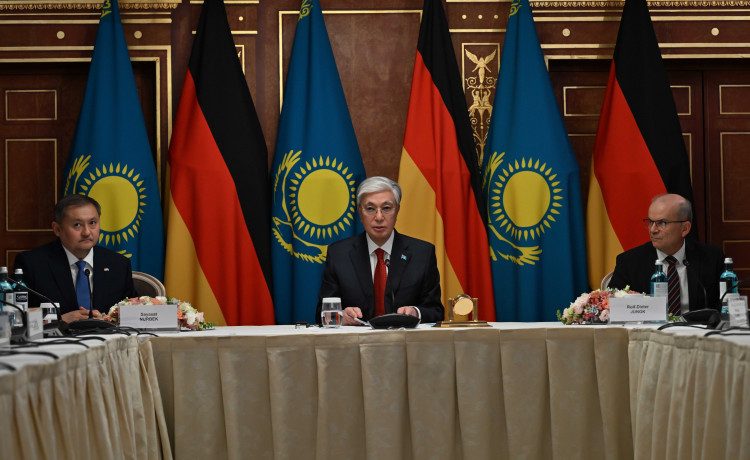
Kazakhstan’s President outlined three areas for academic cooperation with Germany: joint education programmes, research and technology transfer.
English translation · Russian original
In his address, Kassym-Jomart Tokayev highlighted the achievements of educational cooperation between Kazakhstan and Germany. He said these had been made possible by stronger political dialogue, which began with President Frank-Walter Steinmeier's visit to Astana in June 2023.
“Today, 45 Kazakh universities cooperate with around 100 German partners. About 2,000 students from Kazakhstan study in Germany. More than 30 branches and partner offices of foreign universities currently operate in Kazakhstan. These figures speak for themselves. Yet they do not capture the full depth of our partnership. What matters is what we are creating together. Here, I mean a fundamental change in the nature of our cooperation,” the President said.
The President identified establishing Kazakhstan as a leading academic and research hub in Eurasia as one of the country's strategic priorities.
“We are changing the traditional model. Instead of mainly sending young people abroad to study, we are bringing the standards and specialisations of leading international universities to Kazakhstan. Cardiff University, KAIST and the Colorado School of Mines are already represented in our country. Today, we have more than 40,000 international students, and we plan to increase their number to 100,000 by 2029. As a participant in the Bologna Process, our country applies European standards for quality assurance and the comparability of degrees,” he said.
Tokayev said partnerships between universities in the two countries were creating educational and research centres aligned with the needs of Kazakhstan's economy. This work had led to the opening of joint Kazakh-German universities in the Mangystau and East Kazakhstan regions and in Almaty.
“These examples demonstrate an important principle. The strongest academic partnerships are those that address real economic and technological needs. Universities must not exist in isolation from industry. Research must lead to new technologies, while the education system must provide the economy with highly qualified specialists,” the President stressed.
The President then outlined his vision for further cooperation. He proposed three main areas of partnership to move from exchanging knowledge to creating it jointly.
“First, we should expand joint educational programmes and double-degree programmes between our partner institutions. It is important to open new opportunities for students and researchers to work together in both countries. In this regard, I propose launching a special educational exchange programme that will help strengthen academic ties between our countries,” Tokayev said.
The President named joint scientific research as the second important area.
“Kazakhstan, which seeks to integrate into the European Research Area, has begun negotiations to join Horizon Europe as an associated country. Our country is already a full participant in the European partnership on raw materials, with a total budget exceeding €300 million. The TiBeRIUM project is a practical example of this cooperation. Launched this year with €7.5 million in Horizon Europe funding and coordinated by TU Bergakademie Freiberg, the project brings together East Kazakhstan Technical University and the Ulba Metallurgical Plant. Its aim is to develop low-carbon production chains for titanium and beryllium. We should expand precisely this kind of cooperation, bringing together universities, science and industry, strengthening supply chains and enabling a shift from raw materials towards products and technologies with greater added value,” he said.
The third area of partnership, the President said, is technology transfer. Kazakhstan is increasing research spending towards 1% of GDP while creating incentives for companies to invest in university research. In this context, Tokayev invited German businesses to open engineering laboratories and technology transfer centres at joint institutions, expressing readiness to support such initiatives through co-financing.
The President also focused on artificial intelligence, which he said offered prospects for taking cooperation to a new level.
“Under the AI-Sana programme, more than 700,000 students have acquired certified AI skills. We have deployed the alem.cloud supercomputer cluster, opened a specialised research university in this field and adopted one of the region's first AI laws. These efforts are complemented by advanced supercomputing technologies. This creates new opportunities for cooperation with German research institutions and industry. Our technology-oriented younger generation can be a reliable partner for German companies and researchers. Kazakhstan, in turn, can offer a testing ground for applied digital solutions and Industry 4.0 technologies,” he said.
Tokayev also noted the historical connection between Kazakh and German intellectual traditions, citing the Kazakh translation of Johann Wolfgang von Goethe's poem ‘Wanderer's Night Song’ by the Kazakh poet and thinker Abai Qunanbaiuly. He said the translation had become one of the first intellectual bridges between the two peoples.
The President concluded by calling on the heads of leading universities and research institutes in Germany and Kazakhstan to pool the two countries' capabilities to implement new projects.