
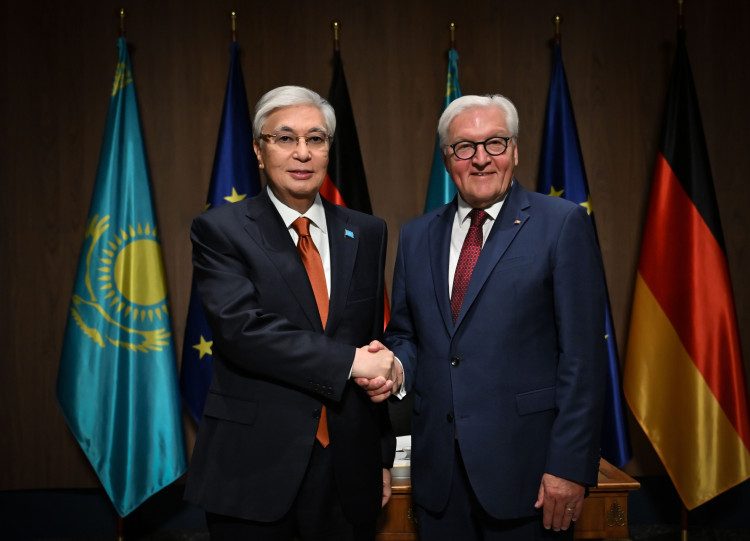
The declaration issued during Kassym-Jomart Tokayev’s official visit sets out the presidents’ priorities for bilateral and regional cooperation.
English translation · Russian original
Joint Declaration of the President of the Republic of Kazakhstan and the President of the Federal Republic of Germany
At the invitation of His Excellency Mr Frank-Walter Steinmeier, President of the Federal Republic of Germany, His Excellency Mr Kassym-Jomart Tokayev, President of the Republic of Kazakhstan, paid an official visit to the Federal Republic of Germany on 29–30 September 2026. On this occasion, the two Presidents adopt the following Joint Declaration:
The Presidents highly value the successful cooperation between the Republic of Kazakhstan and the Federal Republic of Germany since Kazakhstan gained independence. Building on more than three decades of successful cooperation, mutual trust and increasingly intensive political dialogue at the highest level, they look positively upon the continuation of close cooperation.
They recognise the progress achieved and stress the importance of continuing reforms and further modernisation in their countries to create a stable legal and favourable economic environment, while upholding democracy, the rule of law, the protection of human rights, investment security, judicial independence and sustainable development.
The Presidents reaffirm their support for the Strategic Regional Partnership between Central Asia and Germany, launched at the first Central Asia–Germany summit in Berlin on 29 September 2023 and developed further at the second summit in Astana on 17 September 2024. They highly value the outcomes of the foreign ministers' meeting in this format in Berlin on 11 February 2026 and welcome plans to hold the third summit in the near future.
The sides welcome expanding comprehensive cooperation among the Central Asian states, which contributes to the region's autonomy, resilience and well-being.
The Presidents reaffirm their commitment to multilateral cooperation and to the fundamental principles of international law and the United Nations Charter, including respect for the sovereignty, independence and territorial integrity of all states. They stress the importance of resolving disputes and conflicts through peaceful, political and diplomatic means.
The heads of state also stress the need to achieve a comprehensive, just and lasting peace in Ukraine as soon as possible, in accordance with the principles of the United Nations Charter.
The Presidents regard trade, economic and investment cooperation as a central foundation of cooperation. They reaffirm their interest in increasing bilateral trade, broadening the range of products supplied, increasing investment and localising production.
The heads of state welcome the measures already taken to improve operating conditions for German companies in Kazakhstan, including small and medium-sized enterprises, and support further reforms in this area. They note a shared interest in bringing standardisation approaches closer together, taking account of German, European and international standards.
The Presidents note the significant contribution of the Kazakh-German Intergovernmental Working Group on Trade and Economic Cooperation, the Kazakh-German Business Council, the Berlin Eurasian Club, the Delegation of German Industry and Commerce in Central Asia and the German Eastern Business Association to developing business ties and increasing mutual exports.
To deepen industrial cooperation, the sides welcome the joint Roadmap for Industrial, Technological and Raw Materials Cooperation for 2026–2028. Priority will be given to establishing joint production facilities, extracting and processing critical raw materials, increasing the added value of domestically produced goods, and creating reliable and resilient supply chains.
The Presidents welcome close cooperation to strengthen energy security and diversify energy sources and supply routes, including oil and gas supplies to Europe. The sides intend to develop cooperation through the Kazakh-German Energy Dialogue and the H2-Diplo office in Astana to improve the reliability of energy supplies, develop energy corridors, decarbonise industry and expand the use of renewable energy and green hydrogen.
The heads of state note the strategic importance of the Trans-Caspian Transport Corridor for strengthening transport and trade connectivity between Asia and Europe. They welcome its further development as a reliable and competitive route that helps diversify transport links, expand trade and strengthen economic resilience. In this connection, the Presidents welcome initiatives by Kazakhstan, Germany and the European Union to develop transport infrastructure and improve connectivity.
The sides regard digitalisation, artificial intelligence, scientific research and space activities as promising areas of cooperation.
The Presidents note the potential for further agricultural and food-sector cooperation, building on the positive experience accumulated. They attach great importance to bilateral and regional projects and to private-sector initiatives in this field.
The heads of state note with satisfaction the expansion of healthcare cooperation, particularly in medical science, and welcome its further development.
Recognising the serious impact of climate change on water availability and ecosystems, the Presidents give priority to cooperation on water resources, climate, environmental protection, biodiversity conservation and sustainable natural resource management. They regard cooperation in these areas as an important component of bilateral cooperation and the Strategic Regional Partnership between Central Asia and Germany, noting the contribution of the German Federal Government's Green Central Asia initiative.
Recognising the need for a regional approach to transboundary climate and environmental challenges, the Presidents support efforts to establish an environmental and climate partnership between Germany and the Central Asian states, as envisaged in the Berlin Declaration adopted by their foreign ministers on 11 February 2026.
The Presidents welcome cooperation between the Ministry of Water Resources and Irrigation of the Republic of Kazakhstan and the German industry association German Water Partnership. The sides attach great importance to joint water-sector projects.
The Presidents support deeper cooperation in culture, youth policy, sport, science and education. They welcome expanding direct ties between research institutions and universities, implementing joint research projects, promoting academic mobility and training highly qualified specialists. Particular importance is attached to further developing the Kazakh-German University in Almaty, including the possible creation of a new campus, establishing a Kazakh-German school in Astana and cooperating in technical and vocational education. The sides also reaffirm their interest in expanding the teaching and study of German in Kazakhstan's schools and universities.
The heads of state welcome the initiative to establish a Kazakh-German Future Forum as a platform for dialogue among young professionals and future leaders on sustainable development, energy, digitalisation and artificial intelligence. They support holding the first forum in the federal state of Saarland in summer 2027 and the possibility of a subsequent forum in Kazakhstan in 2028.
The Presidents support stronger ties between the two countries' civil societies, noting the important role of Kazakhstan's German community in bringing their peoples closer and developing cultural and interpersonal cooperation. In this context, they highly value the work of the Intergovernmental Commission on Issues Concerning Ethnic Germans Living in the Republic of Kazakhstan.
The heads of state welcome the successful conclusion of negotiations on the Agreement between the Republic of Kazakhstan and the European Union on Visa Facilitation as an important step towards stronger people-to-people contacts, as well as on the implementation of the Readmission Agreement.
The heads of state note progress in the key areas of the Strategic Regional Partnership, including the economy and energy, transport and regional cooperation, resilience, climate and the environment, and contacts between civil societies. They reaffirm their commitment to further strengthening the Central Asia–Germany format as a platform for long-term cooperation focused on concrete results.
The Presidents also note their mutual interest in further strengthening bilateral cooperation by continuing a political dialogue based on trust and expanding relations, particularly in trade and the economy, as well as science, education and culture.