




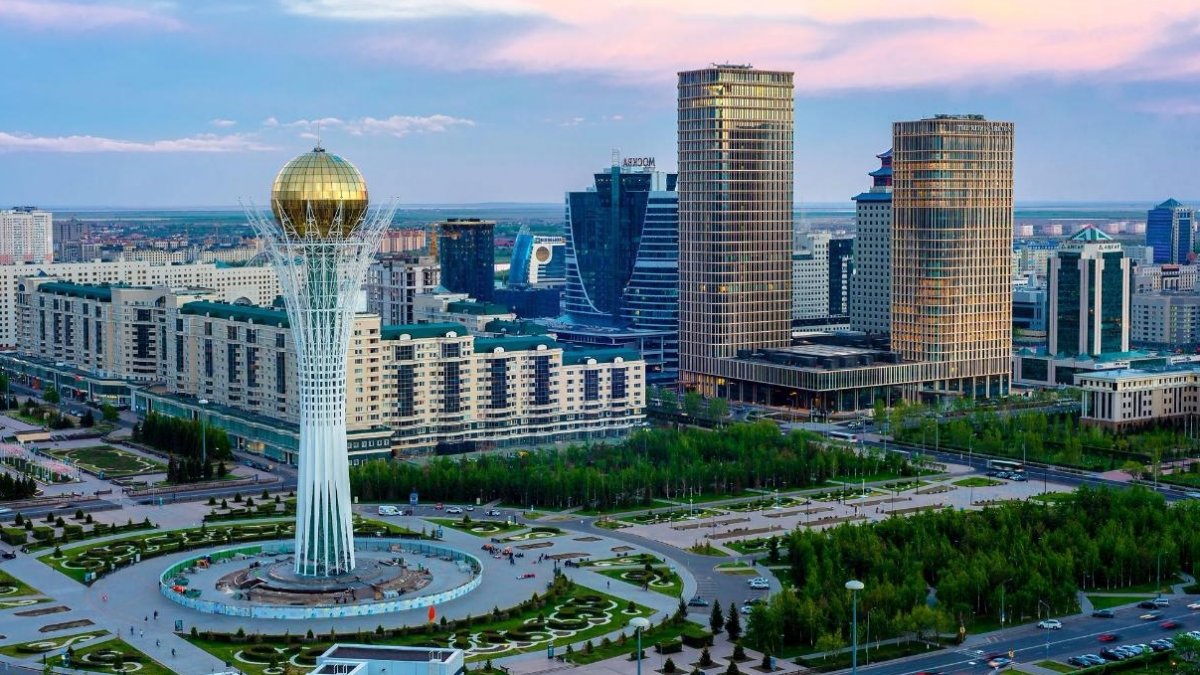
Exactly 21 years ago, on December 10, 1997, the city of Akmola, (now Astana), was declared the capital of the Republic of Kazakhstan.
At the end of 1993, for the first time, the question was raised about the need to transfer the capital from Almaty to another city of the republic. And at the official level, the proposal was announced on July 6, 1994 by Nursultan Nazarbayev at the session of the Supreme Soviet of the republic. The idea of the President was supported by deputies. As a result, on September 15, 1995, the Head of State issued a Decree on the transfer of the capital to Akmola, in which he ordered the formation of a State Commission to organize the work of relocating the higher and central authorities to the newly-minted capital.
On May 6, 1998, Akmola was renamed to Astana, which in translation from Kazakh means “capital”. The international presentation of Astana as a new capital was held on June 10, 1998.
And today, exactly 21 years have passed since the day of the official transfer of the capital to Astana.
Thus, according to the Akimat of Astana, over 20 years the population of the capital has grown from 300.5 thousand to 1 million 8 thousand people. It is interesting to note the fact that if in 1997 the territory of Akmola was only 258 square kilometers, now it is already 797.3 square kilometers.
In 1997, the average monthly nominal wage was only 9,874 tenge, and according to data for January-September 2018, the average salary in the capital was 233,163 tenge.
Industrial production is also impressive. In 1997 they were at the level of 15.1 billion tenge, now this figure is at the level of 487.2 billion tenge.
In addition, GDP growth in 1997 amounted to 25.7 billion tenge, and in 2018 - 2 477.5 billion tenge.
In an interview with the official website of Astana Akimat, Adviser to the President of NC KTZ JSC Farit Galimov, who in 1996 headed the State Commission for the redeployment of higher and central bodies to the city of Akmola, said that the whole country at that time had the task of creating an urban environment that from the regional center would become the capital.
"At that time we needed to imagine what future Astana would be like the capital. It was necessary to develop a master plan for the city, that is, what it will be, its population, what is most important in this city, factories, offices, office facilities. Then we will also it was necessary to tidy up the urban economy, so that the city had heat, water, electricity, everything had to be repaired.Of course, the city had to be maintained, snow removed, swept, respectively, it was necessary to create an intercity communal economy that would do all this.
On the whole, it was necessary to create an urban environment that would gradually turn from a middle regional center into the capital, because this is far from Tselinograd and Akmola, it was a completely different city, ”notes Farit Galimov.
Today, Astana is the center of the Eurasian space, where international events take place.
In the capital, the Congresses of Leaders of World and Traditional Religions, the Astana Economic Forum and other internationally significant events are held on a regular basis. The anniversary summits of the SCO and the OIC have passed. And in early 2011, Astana met the participants of the VII Asian Winter Games.
In addition, at a high level in 2017, the capital of Kazakhstan held the seventh international exhibition EXPO.